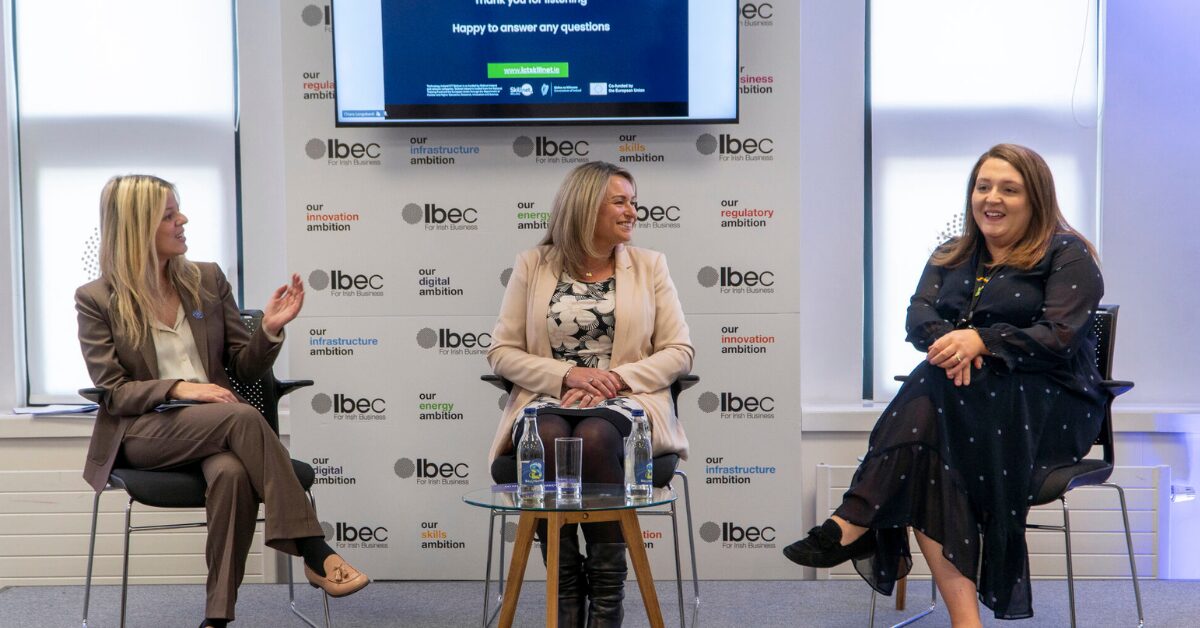
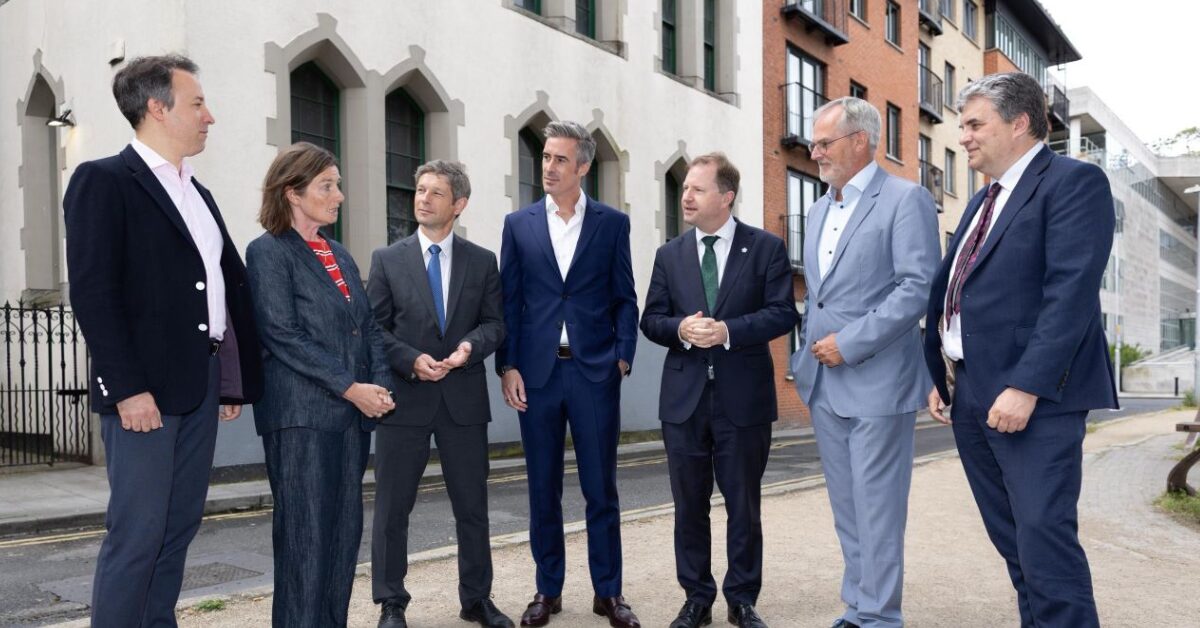
Pictured above from left to right: Chiara Longobardi Esposito Cesariello (DigitalEurope), Susan Kelly (Digital Technology Skills) and Gillian Audet (Technology Ireland Ibec)
On the 11th and 12th May 2026, Dublin became the focal point for Europe’s digital agenda as technology leaders gathered for the DIGITALEUROPE National Trade Association (NTA) Summit. With Ireland preparing to assume the Presidency of the Council of the European Union from July to December 2026, the summit established a vital roadmap for navigating the continent’s digital and industrial ambitions.
Hosted in Dublin by Technology Ireland Ibec, the Summit focused on the conditions Europe needs to strengthen its digital future. While much of the high-level dialogue centered on regulatory simplification, cutting red tape, and managing global competitiveness, a recurring consensus emerged: policy frameworks are only as strong as the human capital backing them.
Representing this operational frontline, Susan Kelly, Director of Digital Technology Skills and Network Director of Technology Ireland ICT Skillnet, delivered a key presentation addressing Europe’s persistent digital skills gap and offering a practical, execution-focused perspective to the delegation.
Bringing a workforce perspective to Europe’s digital agenda
As part of the Summit programme, Susan Kelly was invited to present on Ireland’s approach to upskilling and reskilling, drawing on the Skillnet Ireland model and the work of Technology Ireland ICT Skillnet, a major industry-led skills project managed by Digital Technology Skills.
The session offered a practical counterpoint to the wider policy and competitiveness discussions taking place across the Summit. For many attendees, it was an introduction to how Ireland has built a coordinated, enterprise-led approach to workforce development, linking government support, industry demand and education expertise.c
Susan’s presentation outlined the urgency of the skills challenge. Referencing the World Economic Forum’s Future of Jobs Report 2025, she noted that employers expect 39% of key skills required in the labour market to change by 2030, while 59% of the workforce will require upskilling or reskilling over the same period.
The Skillnet Ireland Framework: A Best Practice Model
A central theme of Susan’s presentation was that Ireland’s competitive advantage is not only its talent base, but the way it coordinates across government, enterprise and the education system. Susan outlined how the Skillnet Ireland model works in practice.
Employer contributions to the National Training Fund are channelled through an industry-led network model, allowing training priorities to be shaped by the real needs of businesses and workers. The approach combines national coordination with responsiveness on the ground, creating a structure that can move with the pace of economic and technological change.
Recognised by both the European Commission and the OECD as a global best practice model for workforce development, Skillnet Ireland operates through a distinct public-private mechanism:
- Enterprise-Led Funding: The framework routes 1% of payroll via employer PRSI contributions into a dedicated National Training Fund.
- Industry Relevance: Businesses directly co-invest with the state to co-design training solutions, ensuring that every programme addresses immediate market shortages.
- Proven Scale: In 2024, the model supported over 24,000 companies and upskilled more than 90,000 workers, delivering over €76 million in programmes with €28 million co-invested by industry.
By removing the administrative burden from individual businesses and subsidising programmatic costs, this ecosystem allows companies to close technical skills gaps dynamically and at speed.
Susan’s presentation demonstrated how this model is delivered through Technology Ireland ICT Skillnet. Its training portfolio spans high-priority areas including artificial intelligence, cybersecurity, cloud, data analytics, software architecture, quantum, innovation and transformation, while also supporting bespoke enterprise training initiatives designed around specific business needs.
Digital Technology Skills: Transforming Competitiveness at Scale
As a leading entity for digital skills and innovation, Digital Technology Skills manages and supports a portfolio of national and European initiatives focused on workforce development. Our extensive innovation network allows us to manage skills transformation at national and international levels.
Locally in Ireland, we have worked with over 6,000 companies, collaborated with more than 10 national universities, and provided access to in-demand training and trusted credentials to over 14,000 individuals. This includes driving specialised programmes across high-demand technical areas like Artificial Intelligence, Cybersecurity, Data Analytics, and Cloud Computing.
As a formal member of the EU Pact for Skills, Digital Technology Skills has partnered with over 100 industry and academic institutions across the continent. To date, we have successfully supported the delivery of 17 Pan-European projects valued at over €60 million.
Speaking after the event, Susan Kelly, Director of Digital Technology Skills, noted: “As Europe shifts its focus from legislative complexity to real-world execution ahead of the Irish EU Presidency, scaling talent must be treated with the same urgency as physical infrastructure,” adding that “true innovation doesn’t just happen because of policy; it scales when the existing workforce is structurally equipped to implement it. Our mission at Digital Technology Skills is to continue building the collaborative frameworks that turn European digital ambition into tangible industrial capability.”
Looking Ahead to the 2026 Irish Presidency
The DIGITALEUROPE Summit provided an important platform to demonstrate how this work connects to a much larger European challenge. As Ireland prepares to take on the EU Presidency, the opportunity is not only to influence policy debate, but also to show how practical, collaborative skills models can help turn digital ambition into lasting capability.
The transition to an economy led by applied research, digital resilience, and industrial scaling will be a central pillar of the upcoming EU Council Presidency term. By bringing together structural industry embedding, corporate co-investment, and agile university partnerships, the operational model championed by Digital Technology Skills provides a ready-made template for building Europe’s digital backbone.
Through continued pan-European collaboration, we remain committed to ensuring that the next wave of technological transformation is driven by a workforce that is fully prepared to compete globally.
![How an Irish skills organisation is helping Europe build advanced digital talent [TechCentral Profile]](https://digitaltechnologyskills.ie/wp-content/uploads/2026/06/How-an-Irish-skills-organisation-is-helping-Europe-build-advanced-digital-talent-TechCentral-Profile.jpg)